Left/Right: navigate | B: static | Esc: index
Part of road-casts.com/portfolio
AIML-500AI history
01 / 15
1950 - July 10, 2026

AI Progress
Was Uneven

Breakthroughs accelerated when six conditions reinforced one another. Momentum cooled when promises outran demonstrated capability and sustainable economics.

Algorithms
Data
Compute
Funding
Institutions + labor
Demand
Lens: Dick | AI Index 2026 A causal history, not a milestone parade
PatternOrientation
02 / 15

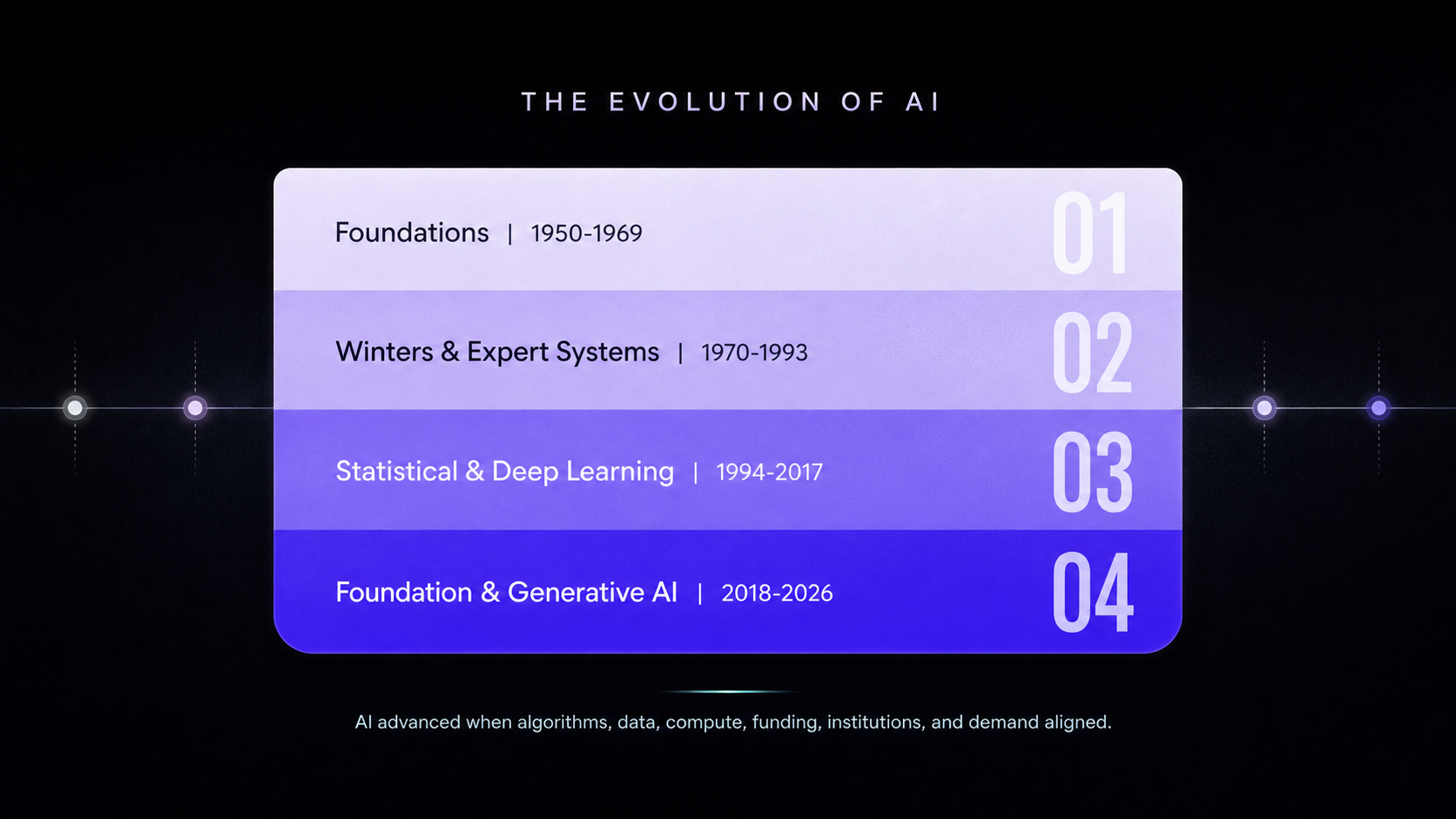
Four Eras, Two Winters

Overview timeline of four AI eras and two AI winters
The era boundaries overlap; the dates are anchors, not hard walls.AI-generated visual summary
Sources: IEEE Computer Society | Our World in Data Full map before the close-up
FoundationsField formation
03 / 15

The Field Takes Shape, 1950-1956

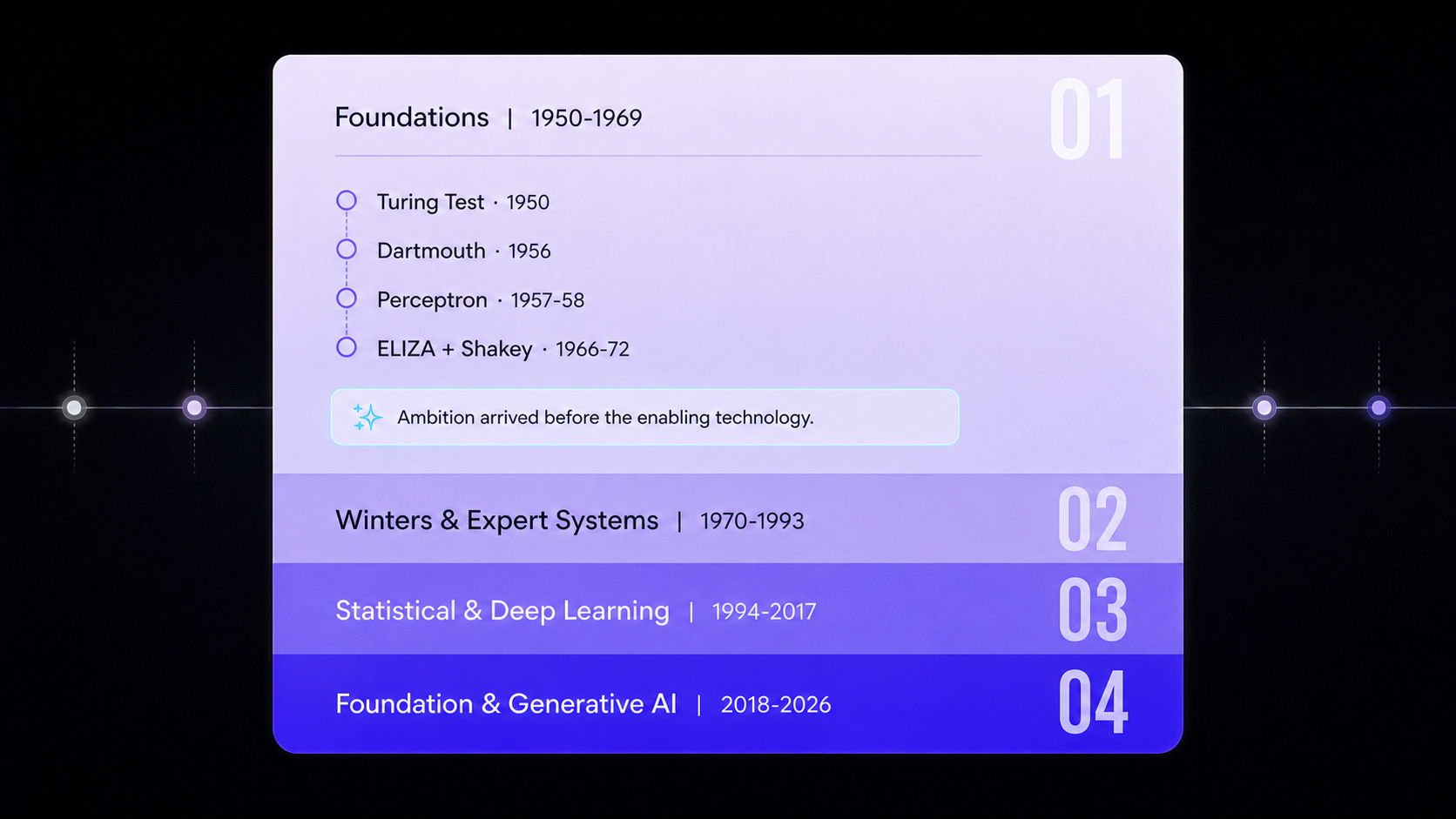
1950

Turing reframed the question.

The imitation game replaced a vague debate about thinking with observable behavior and a testable research question.
1955/56

Dartmouth organized a field.

The proposal named artificial intelligence and joined language, abstraction, neurons, learning, and problem solving in one program.

A question became a field before the field had a scalable recipe.
Turing (1950) | Dartmouth proposal | Dick Framing is not invention
FoundationsFirst winter
04 / 15

Early AI Meets Its First Winter, 1957-1980

Foundations era timeline from Turing through early neural networks and language programs
PromiseSymbolic demos and perceptrons
LimitsWeak transfer, scarce data and compute
ScrutinyALPAC 1966; Lighthill 1973
CoolingUneven contraction in funding and confidence

No single report caused a worldwide shutdown; relevant research continued.
ALPAC | Lighthill | UK Parliament history A multi-causal contraction
RecoveryExpert systems
05 / 15

Expert Systems Turn Knowledge into Products, 1970s-1985

01

Domain expert

Supplies bounded, practical knowledge.

>
02

Knowledge engineer

Translates expertise into explicit rules.

>
03

Rules + inference

Matches facts to encoded knowledge.

>
04

Recommendation

Creates value inside a narrow domain.

MYCIN and XCON restored practical value by trading generality for expertise. The cost was brittleness and constant rule maintenance.
MYCIN history | XCON paper | Kautz Human expertise was part of the system
Learning lineageBackpropagation
06 / 15

Backpropagation Reopens a Learning Lineage, 1986

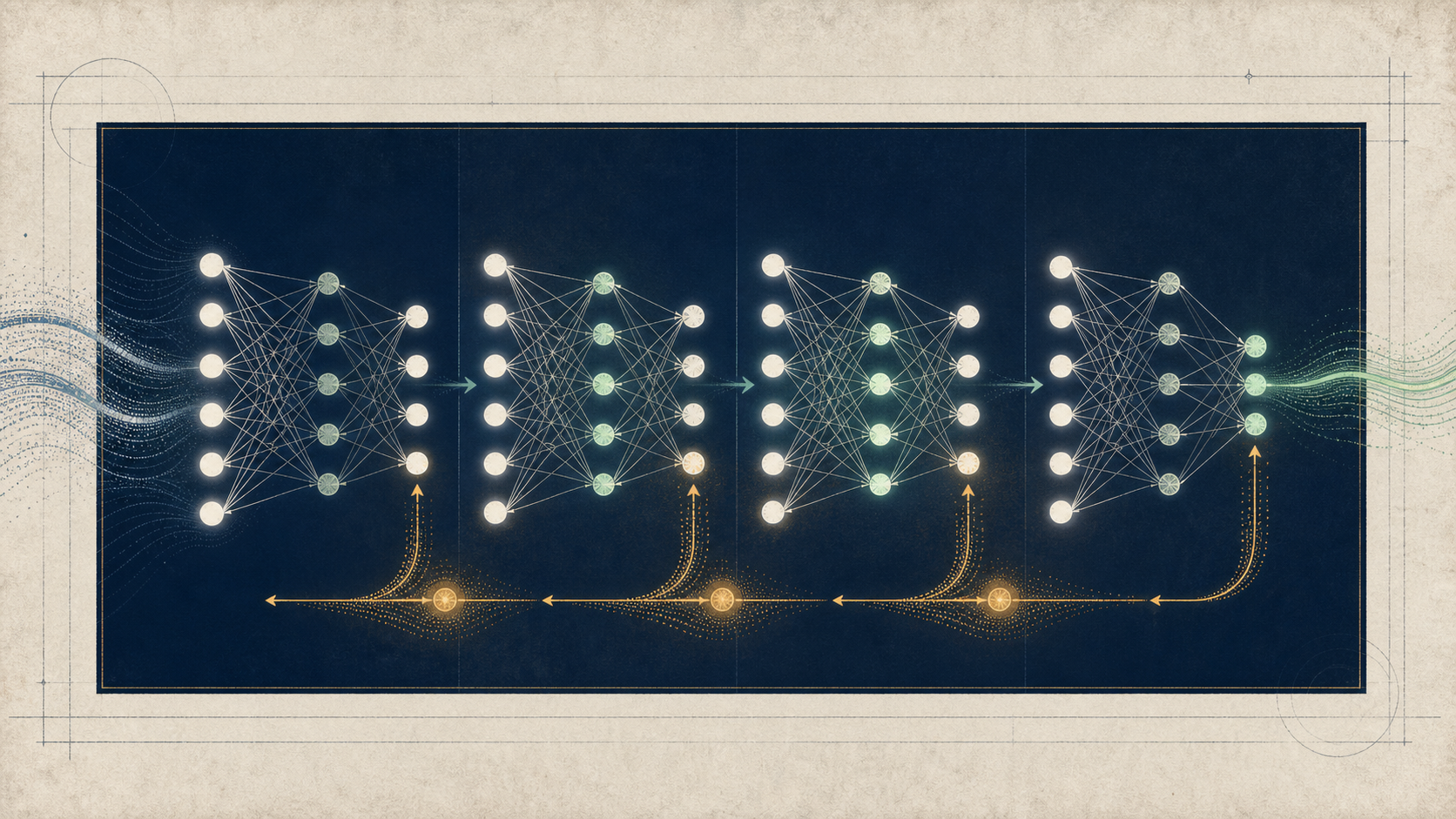
Editorial illustration of multilayer neural networks with a backward error signal
What changed

An effective training procedure made learned hidden representations practical to demonstrate.

What was still missing

Large datasets, affordable accelerators, and mature software infrastructure.

The 1986 paper popularized a lineage; it did not invent all of backpropagation.
Rumelhart, Hinton and Williams (1986) An algorithm can arrive before its ecosystem
CorrectionSecond winter
07 / 15

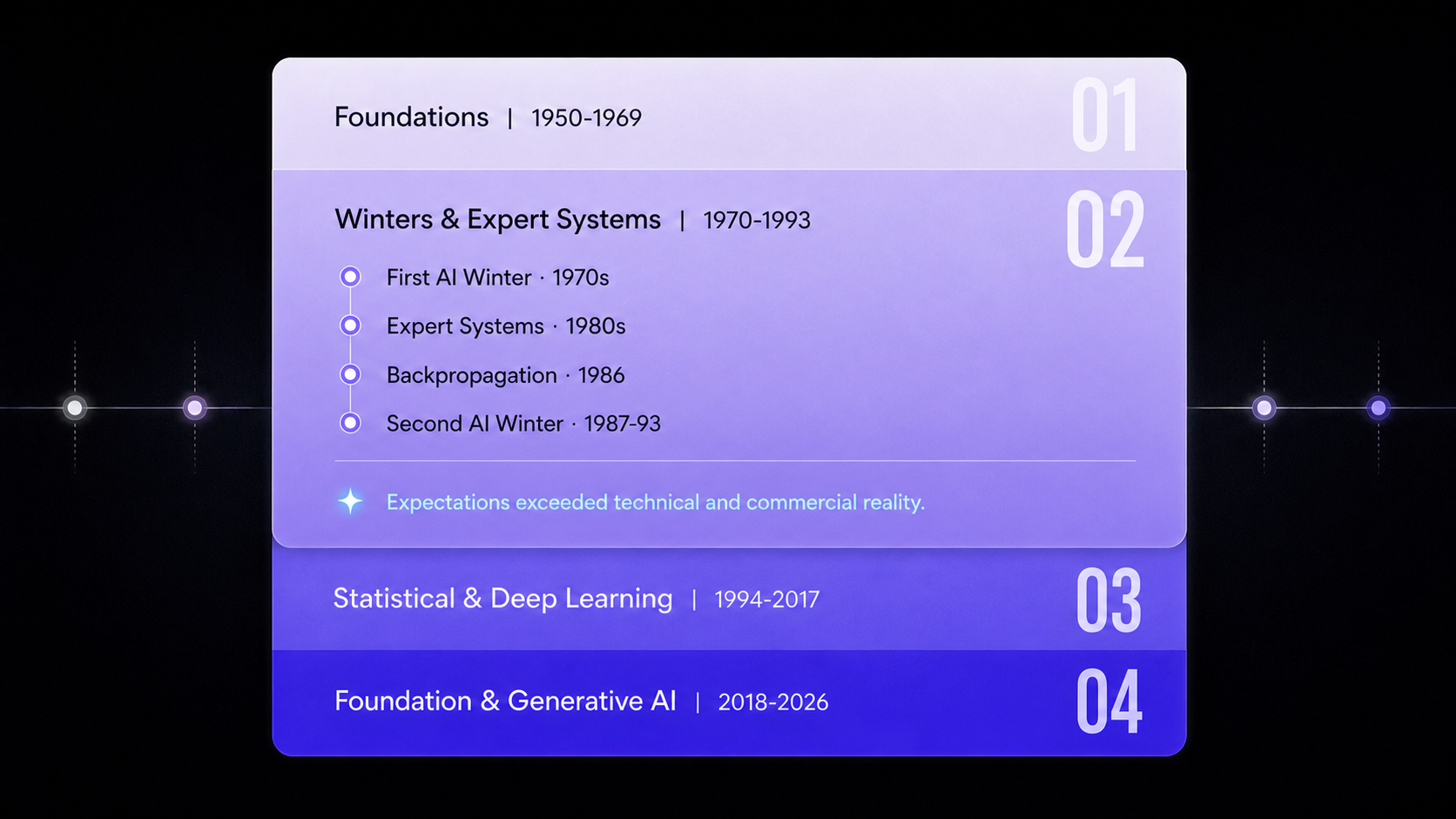
Expert Systems Hit Technical and Economic Limits, 1987-1993

Timeline of the first and second AI winters, expert systems, and backpropagation

Technical

Brittle rule bases and poor handling of change or uncertainty.

Economic

Expensive knowledge upkeep and declining value of specialized hardware.

Institutional

Disappointed programs, retreating capital, and weaker confidence.

The AI label cooled; statistical learning and neural-network research continued.
Kautz (2018) | Expert-systems history The economics broke with the technology
Statistical turnBounded success
08 / 15

Narrow Systems Restore Credibility, 1990s-1997

Statistical ML

Measure generalization.

Probability, data, and shared evaluation shifted attention from hand-written intelligence to performance on defined tasks.

Data + optimization + test sets
Bounded win

Deep Blue masters chess.

Search, chess expertise, and specialized hardware defeated a world champion inside one formal domain.

Task mastery is not general intelligence.
Support-vector networks | IBM Deep Blue Credibility returned through measurable tasks
ConvergenceDeep learning
09 / 15

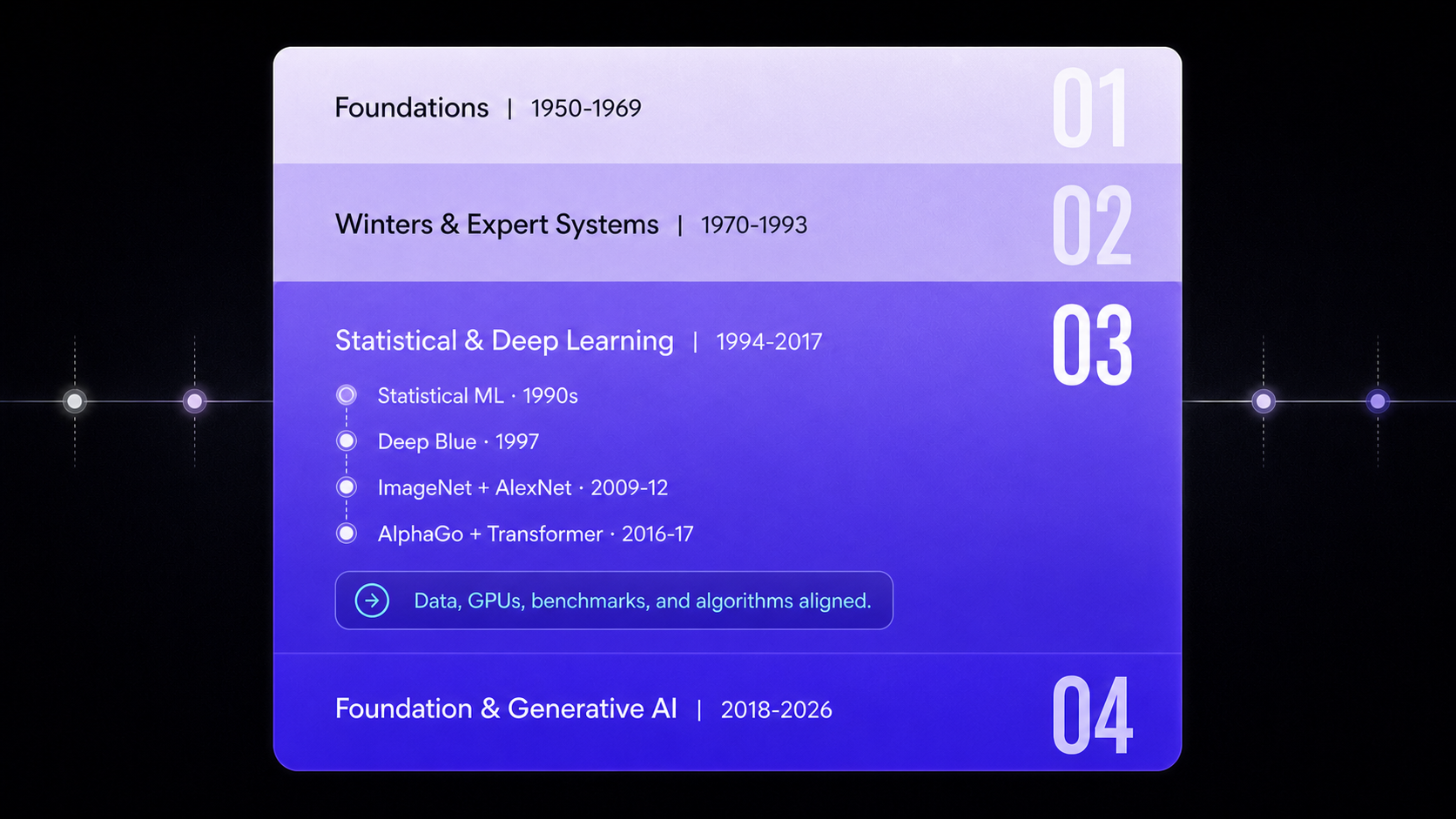
ImageNet Aligns Data, Labor, Compute, and Algorithms, 2009-2012

Timeline of statistical machine learning, Deep Blue, ImageNet, AlexNet, AlphaGo, and Transformer
DATAImageNet
LABORHuman annotation
COMPUTEGPUs + CUDA
ALGORITHMCNNs + backprop
INSTITUTIONShared benchmark
DEMANDVisual products
2012 was convergence, not invention.
ImageNet | AlexNet | Annotation labor The clearest alignment event
ExpansionTwo breakthroughs
10 / 15

Deep Learning Expands Its Playbook, 2016-2017

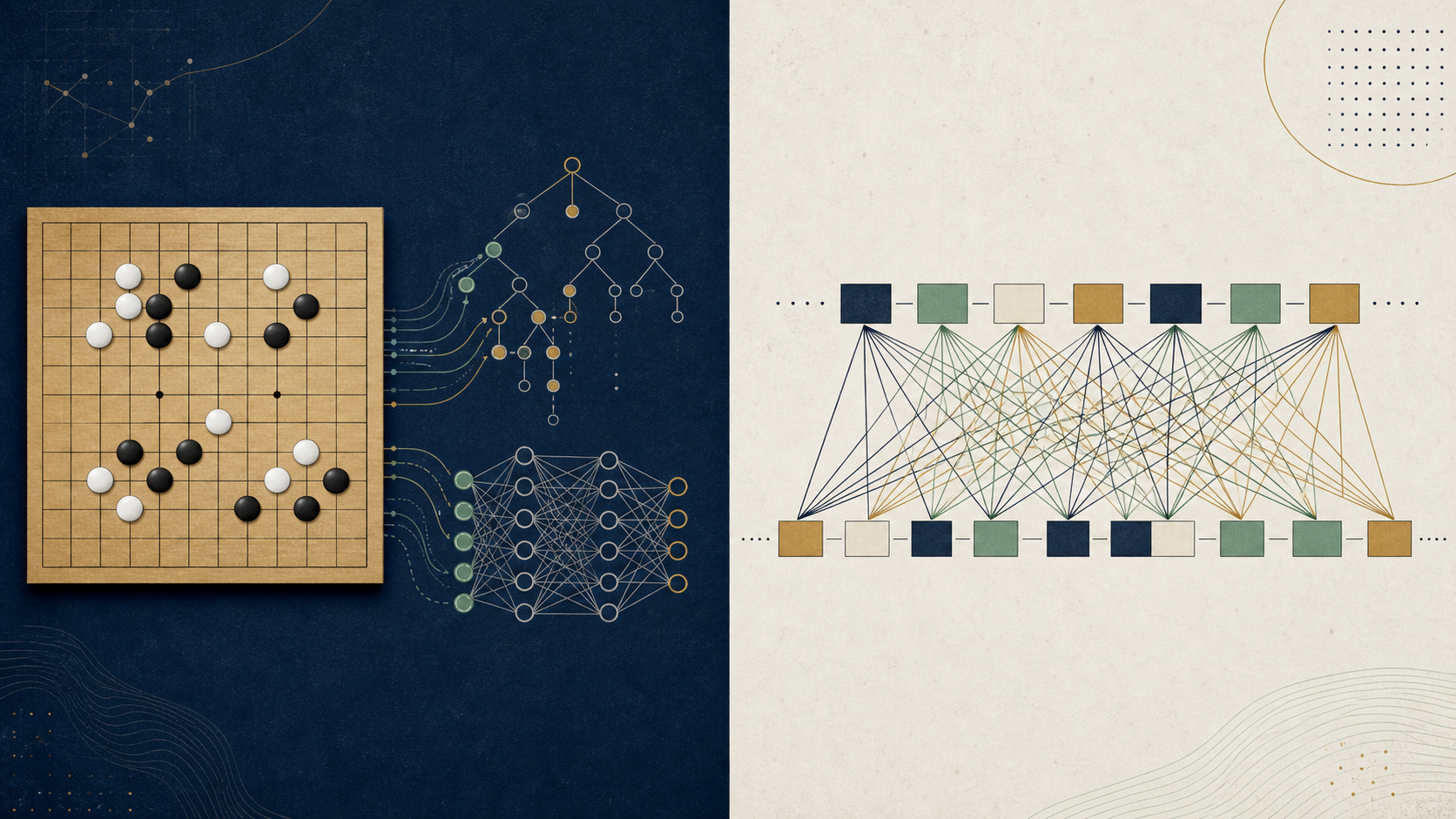
Editorial diptych showing AlphaGo's combined methods and Transformer's attention relationships

AlphaGo: a method stack

Networks + expert games + self-play + search, inside Go's closed rules.

Transformer: a reusable architecture

Attention enabled parallel sequence training, first demonstrated in translation.
AlphaGo | Attention Is All You Need Different achievements, different boundaries
Foundation modelsScale
11 / 15

GPT-3 Makes Scale a Strategy, 2020

Broad data
Accelerators
Large model
Capital
>
One pretrained model
Many tasks
Foundation model, 2021: a reusable base model adapted across downstream tasks. Reuse expands capability and propagates risk.
GPT-3 | Stanford CRFM Pretraining became an operating model
DistributionGenerative AI
12 / 15

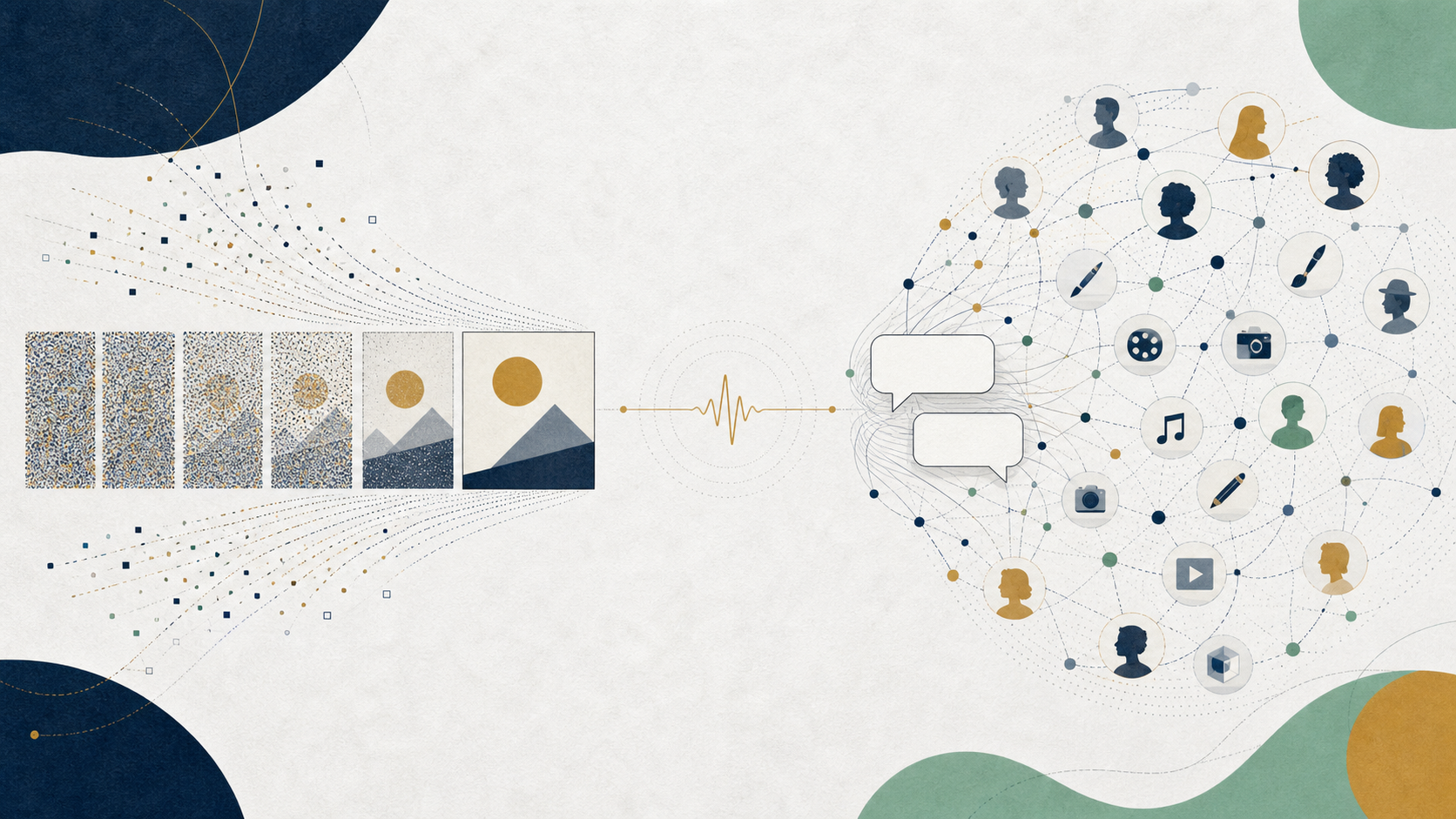
Generative AI Creates Mass Demand, 2022

Editorial illustration of diffusion image generation and conversational AI spreading to mass users
Diffusion

Noise becomes media; latent methods make high-resolution generation more practical.

ChatGPT

Human feedback, conversation, and distribution turn model capability into public demand.
The inflection was technical and social.
DDPM | Latent diffusion | ChatGPT Demand became an enabling condition
GuardrailEvaluation
13 / 15

Benchmarks Are Milestones, Not Destiny

Deep Blue
Chess
Proved elite task performance.
Did not prove broad learning or transfer.
AlexNet
Image classification
Proved learned visual features could scale.
Did not prove robust visual understanding.
AlphaGo
Go
Proved strategic mastery in closed rules.
Did not prove open-world reliability.
ChatGPT
Language interaction
Proved broad, useful interaction.
Did not eliminate uneven reliability.
Task success is not general intelligence.
OWID benchmark cautions | AI Index 2026 | Dick Results are real; interpretations require limits
Current horizonProvisional
14 / 15

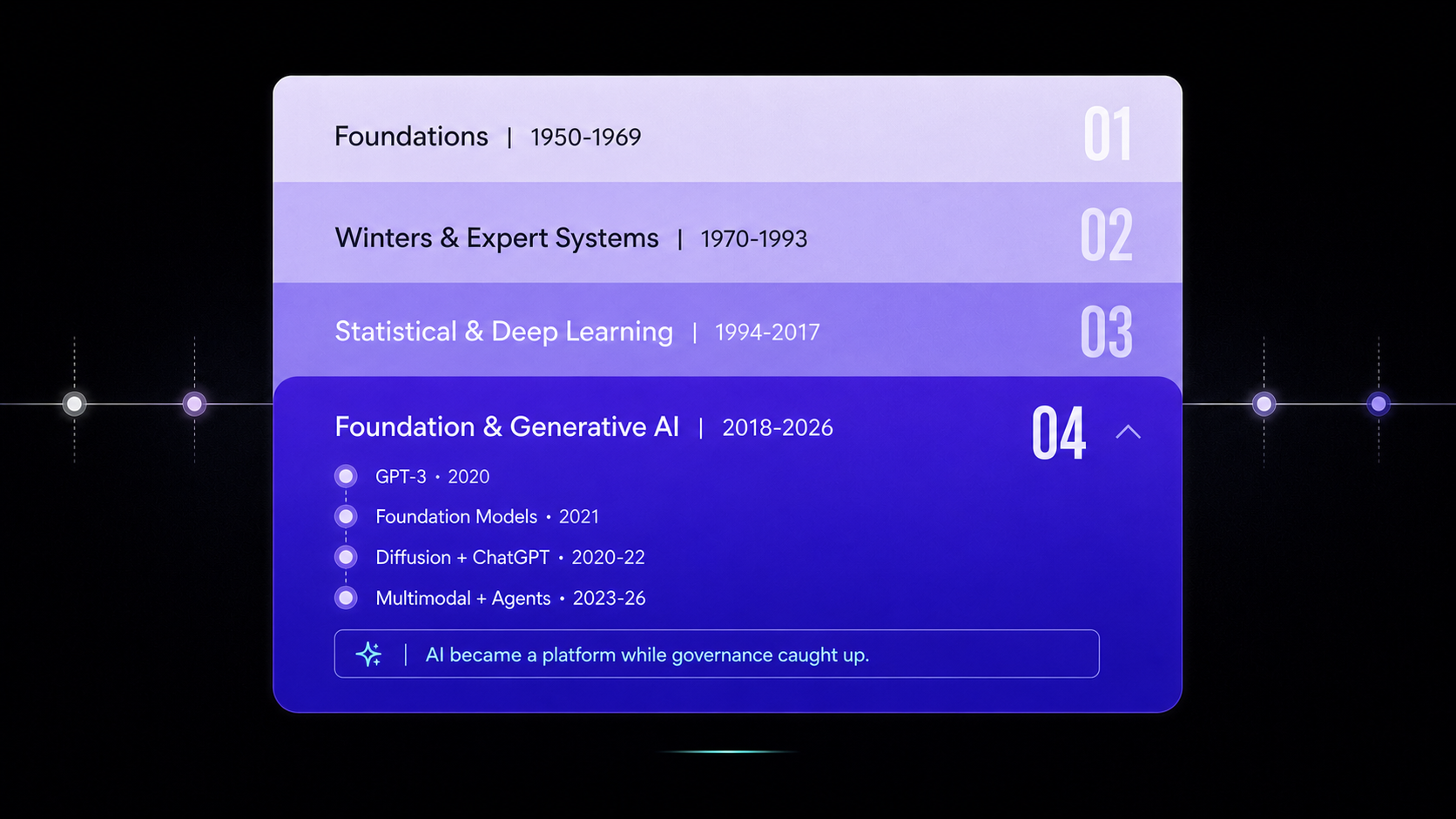
The Frontier Becomes a System, 2023-July 2026

Timeline of foundation models, generative AI, multimodal systems, and agents
Capability risesReliability remains jagged.
Adoption spreadsOwnership and compute concentrate.
Demand expandsChips, energy, evaluation, and policy constrain scale.
Evidence frozen July 10, 2026. The significance of the newest releases remains provisional.
AI Index R&D | Economy | Performance | EU AI Act A system-level snapshot, not a release parade
VerdictThesis test
15 / 15

AI Advances When Six Conditions Reinforce

Era
Algorithms
Data
Compute
Funding
Institutions
Demand
Foundations
Expert systems
Deep learning
Foundation era
Qualitative synthesis, not a measured score Limited Partial Reinforcing
01 Winters were uneven; research continued.
02 Benchmarks were bounded, not destiny.
03 Institutions shaped what counted as intelligence.
Verdict: strongly supported, not universally proven.
Dick et al. | OWID / Epoch compute data | AI Index 2026 Lens informed by public scholarship; no endorsement implied